✨ When Your System Feels Overloaded
Some days hit like a surprise system update. Slow, inconvenient, and arriving right when you’re already juggling a dozen mental tabs.
Today was one of those days.
I woke up at 7:00 a.m. to bright sunshine streaming through the window. The sky looked clear, and everything felt like it was off to a good start. But by the time I got dressed, headed downstairs, and logged on for work, the light was gone. Gray clouds had rolled in, turning the morning gloomy.
A surefire sign that something was brewing ahead.
The workday itself wasn’t chaotic in the obvious sense. There were no major outages, no emergency alerts, no full-scale incidents. Instead, it was what I like to call quiet chaos. The kind that slowly accumulates in the background. Small stressors. Ongoing responsibilities. Unanswered questions. Mental task switching. The endless hum of trying to keep everything running smoothly.
By the end of the day, I was grateful to log off and finally reboot.
If you’ve ever felt mentally overloaded, emotionally heavy, physically tense, and situationally stressed all at once, you’re not alone. And you’re definitely not broken.
You’re just running a high-performance system without a reboot.
Welcome to FirewallCipher, where we turn digital chaos into cosmic clarity and where cybersecurity becomes a language for self-care.
🛡️ Mental Overload = Too Many Tabs Open
Just like Windows checks every dependency before installing an update, your mind tries to process every task, expectation, conversation, and concern at the same time.
No wonder it feels slow.
The human brain wasn’t designed to keep fifty browser tabs open indefinitely. Yet that’s exactly what many of us attempt every day.
Digital Self-Care Move
Close one mental tab.
Not all of them. Just one.
Choose the least urgent thought and intentionally set it aside for tomorrow.
Your brain will thank you for the freed-up RAM.
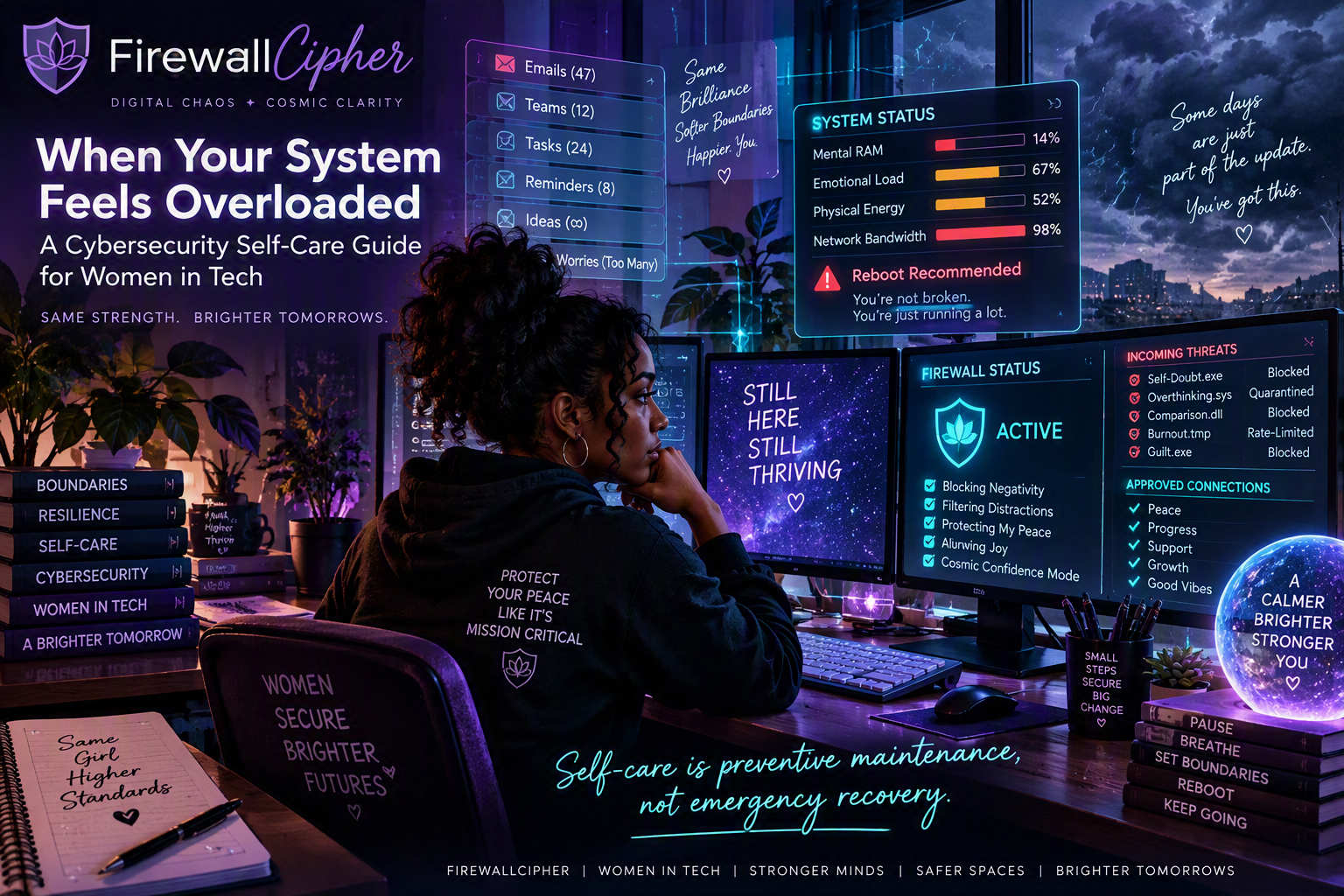
Self-care is preventive maintenance, not emergency recovery.
“Burnout isn’t always a system crash. Sometimes it’s years of ignored warning logs.”
💫 Emotional Heaviness = Background Processes Running
Sometimes you feel emotionally heavy without a single dramatic reason.
That’s because emotions don’t disappear when they’re inconvenient. They continue running quietly in the background, consuming resources even when you aren’t actively thinking about them.
Your system isn’t failing.
It’s multitasking.
Digital Self-Care Move
Name the feeling like you’d name a process:
- Stress.exe
- Fatigue.dll
- Overthinking.sys
- ImposterSyndrome.tmp
Once you identify it, it becomes something you can observe instead of something that controls you.
Awareness is often the first patch.
🔧 Physical Tension = System Throttling
Your body is your hardware.
When your shoulders are tight, your jaw is clenched, and your muscles are exhausted, your entire system operates in a reduced-capacity mode.
Stress doesn’t stay in your head.
It caches itself in your neck, shoulders, hands, and back.
Digital Self-Care Move
Run a quick physical reboot:
- Unclench your jaw
- Relax your shoulders
- Inhale for four seconds
- Exhale for six seconds
- Stretch your hands like you’re typing cosmic code
Hardware maintenance matters.
Even the strongest systems need cooling.
🌐 Situational Stress = Network Congestion
Life throws alerts, notifications, scope changes, surprise meetings, shifting priorities, and unexpected tasks at you.
Before long, your internal alert queue starts looking like an overwhelmed SOC dashboard.
Everything needs attention.
Everything seems urgent.
Everything is competing for bandwidth.
And just like your laptop, you can’t download new problems when your network is already congested.
Digital Self-Care Move
Pause incoming connections.
Say “not right now” to one thing today.
Protect your bandwidth.
Remember: not every request deserves immediate access to your time and energy.
🔒 Background Stress = The Constant Hum of the Firewall
This is the quiet stress.
The persistent hum that never fully disappears.
The invisible workload of maintaining boundaries, anticipating challenges, solving problems, and protecting what matters.
Many women in technology carry this burden every day.
We don’t always notice it because it becomes normal.
But just because something is familiar doesn’t mean it’s sustainable.
Your internal firewall has been scanning for threats all day.
That’s exhausting.
But it’s also proof of your resilience.
Digital Self-Care Move
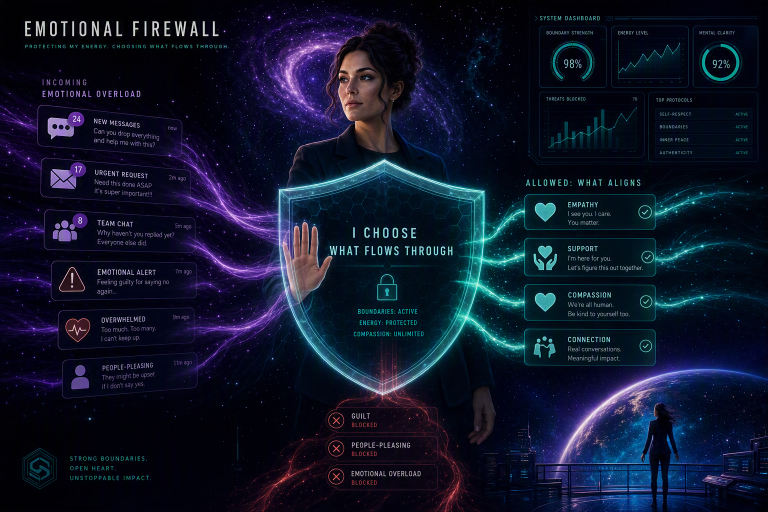
Update your firewall rules:
Allow:
- Joy
- Rest
- Support
- Curiosity
Block:
- Unnecessary guilt
- Comparison
- Perfectionism
Rate-Limit:
- Self-criticism
- Catastrophic thinking
Enable:
- Cosmic Confidence Mode
Your security policies deserve periodic review too.
🔍 FirewallCipher Challenge
Before the day ends, conduct a personal security audit.
Ask yourself:
- What thought is consuming the most bandwidth?
- Which obligation needs a stronger boundary?
- What can be archived until tomorrow?
- What deserves more attention and care?
Then make one update.
Not ten.
Not five.
One.
Because sustainable systems don’t improve through panic.
They improve through maintenance.
✨ The Cosmic Takeaway
High-performing systems still require downtime.
Firewalls need updates.
Networks need maintenance.
Hardware needs cooling.
Human beings are no different.
If you’re feeling overloaded today, it isn’t evidence that you’re failing.
It’s evidence that you’ve been carrying a lot.
Give yourself permission to pause.
Apply the patch.
Restart when needed.
And remember:
You are not the error message.
You are the administrator.
You are the firewall.
You are the system.
You are the cosmic code that keeps everything running.
XOXO,
jamie15146